Smart Investment Property Choices in Maplewood MN
April 2, 2026
April 2, 2026
Are you thinking about buying a small investment property in Maplewood? It can be a smart way to build long-term income, but the right deal is about more than finding a home with extra bedrooms or a second unit. You need to understand local rents, zoning, licensing, and how a property fits the city's rules before you move forward. Let’s dive in.
Maplewood offers a mix of stability and accessibility that many small investors look for. According to the U.S. Census QuickFacts for Maplewood, the city has 40,142 residents, 15,210 households, and a 71.8% owner-occupied housing unit rate.
That matters because a more owner-occupied housing base can point to steadier neighborhood conditions and longer-term appeal. The same Census profile shows 90.9% of residents lived in the same house one year earlier, which suggests Maplewood is not an especially transient market.
For investors, that does not guarantee performance. It does mean you may be looking at a market where well-maintained rentals can compete in a community with stable housing patterns and established demand.
Current market trackers place Maplewood home values in the mid-$300,000s, while rents are generally in the mid-$1,400s to about $1,500. Zillow's Maplewood home value index was $336,965 as of February 28, 2026, and the same source showed an average rent of $1,499.
Other market signals are in a similar range. Redfin reported a $335,000 median sale price in February 2026, with homes selling in about 44 days and at roughly 99% of list price, while Zumper's March 2026 median rent came in at $1,445. Since these sources use different methods and reporting dates, it is best to treat them as directional guides rather than exact matches.
If you are underwriting a purchase, this is a useful starting point. It helps you compare likely rental income against financing, taxes, insurance, repairs, reserves, and any city compliance costs.
Not every small investment property fits the same zoning category. In Maplewood, the parcel and zoning district matter just as much as the building itself.
Single-unit dwellings are permitted in multiple residential districts under the city's use table in the 2023 zoning update materials. If you are buying a single-family home as a rental, your main questions are usually straightforward.
You will want to look at condition, expected rent, maintenance needs, and whether the numbers work after all monthly and annual costs. A clean, well-located home is not automatically a good investment if the rent does not support the total carrying cost.
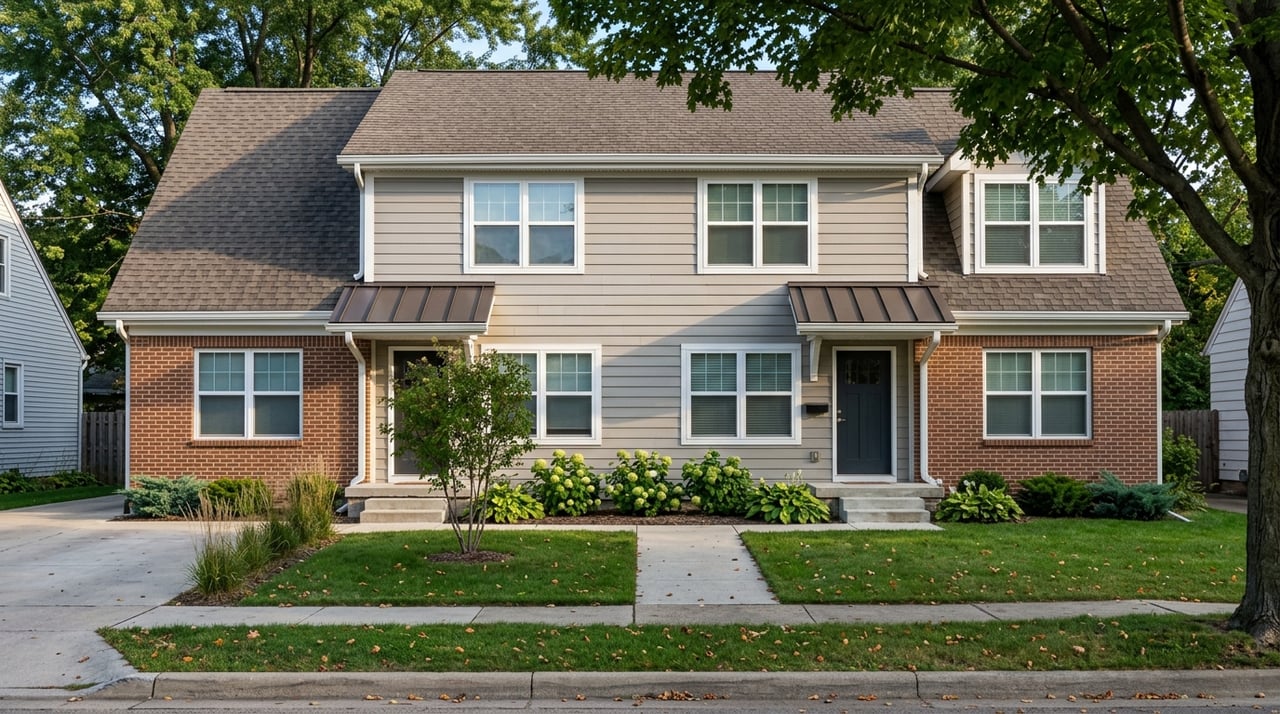
Maplewood defines a duplex as a building occupied exclusively by two families. The city states that the R-2 residence district is intended for two-unit and attached single-unit dwellings, and duplexes are permitted there, according to the city workshop packet and code summary.
This is where zoning becomes very practical. The code shows a 12,000-square-foot minimum lot area for two-unit dwellings in R-2, and there are also front-yard parking limits. That means not every parcel will support the same use, and an older property is not automatically easy to convert, expand, or redevelop.
The city also notes that in R-3, duplexes are only allowed as part of a townhouse development. So before you get too attached to a listing, confirm the property's exact zoning and how the current structure fits that district.
For triplexes and similar properties, Maplewood uses a different framework. The city defines a multiple dwelling as a building designed exclusively as a residence for three or more families, and the R-3 residence district is intended to accommodate townhouses and apartments.
Within that district, Maplewood separates uses into R-3A apartment buildings with 3 to 17 units, R-3B buildings with more than 17 units, and R-3C townhouses. For buyers looking at a triplex-style investment, this distinction matters because the property belongs in the city's multiple-dwelling framework, not the standard single-family or duplex bucket.
If you are investing from out of town, zoning verification should happen early. Maplewood says it has 18 zoning districts and offers an interactive zoning map and zoning information page to help owners and buyers understand parcel-level rules.
The city also offers zoning letters for $100 that explain what can and cannot be done with a property based on its current zoning and history. That can include legal land uses, performance standards, development history, and compliance information.
This step can save you from expensive assumptions. A property that looks like a great duplex or redevelopment play on paper may come with lot-size, parking, or use limitations that change the math.
Maplewood requires rental owners to pay attention to licensing, not just acquisition costs. According to the city's Rental Housing Licensing Program, unless exempt, any person or business offering a dwelling for rent must have a rental property license before tenants move in.
The city states that each owner must complete a background investigation at application and every three years. First-time license applications also require an on-site inspection.
For multifamily properties with four or more units, Maplewood inspects on a 25% annual unit cycle. The city lists annual fees of $150 plus $50 per unit, which should be included in your operating budget from day one.
Parking sounds like a small detail until it becomes a problem. Maplewood's zoning information explains that the city sets standards for setbacks, parking, height, and materials, and the residential parking rules require hard-surface parking, prohibit parking on grass in the front yard, and limit driveway coverage on single-unit and duplex lots.
Parking ratios also vary by use and district. In other words, do not assume one rule applies everywhere in Maplewood.
This matters when you are reviewing an older home, a converted property, or a lot with limited space. If parking does not work under current code, the property's income potential and future flexibility may be more limited than you expected.
A promising investment property should make sense both on paper and in practice. In Maplewood, a few local factors deserve extra attention.
Maplewood's average household size is 2.61, and 23.0% of residents are under 18, based on Census data. While that is not a city policy, it does suggest that 2-bedroom and 3-bedroom rentals may be especially relevant in the local market.
Current Zillow rent tracker data in the research report showed about $1,528 for a 2-bedroom and $2,350 for a 3-bedroom. Those figures can help you pressure-test income projections by unit mix, especially if you are comparing a single-family rental against a smaller multifamily option.
Licensing fees, inspections, and site rules all affect your bottom line. These costs are not dramatic on their own, but together they should be part of your underwriting and reserve planning.
A property that looks affordable at first glance may be less attractive after you account for licensing, repairs needed for compliance, and parking or layout upgrades. That is why due diligence matters so much in a city with clear rental standards.
Because Maplewood remains more owner-occupied than renter-occupied, exterior condition can matter for both tenant demand and future resale. Curb appeal, maintenance, and usable parking may shape how the property performs over time.
That does not mean every rental must be fully updated. It means properties that present well and function cleanly may have an advantage in a stable, predominantly owner-occupied community.
Even with solid rent potential, you still need a conservative plan. Compare projected income against debt service, vacancy, maintenance, repairs, reserves, taxes, insurance, and licensing costs.
It is also wise to talk with your lender, CPA, and attorney about financing structure, depreciation, entity setup, and tax treatment. Good investing is not just about buying the right property. It is also about setting it up the right way.
Overall, Maplewood looks workable for small long-term rental investments, especially when the property aligns cleanly with zoning and licensing requirements. The strongest opportunities are likely to be the ones where the parcel, layout, and use all fit city rules without major surprises.
If you are exploring small investment properties in Maplewood, it helps to have a local guide who can help you sort through neighborhood context, property fit, and the practical details that matter before you write an offer. When you are ready to talk through options, connect with Gary L Bredeson for clear, hands-on guidance in Maplewood and the eastern Twin Cities suburbs.
Stay up to date on the latest real estate trends.
With nearly two decades helping clients in White Bear Lake and the Twin Cities, I know the local market inside and out. Whether you’re buying your first home or selling your last, I’ll put my knowledge and dedication to work to help you achieve the best outcome. Let’s start your journey today.